CAT4 Results Explained – Understand Scores in Minutes
Understand your child’s or student’s CAT4 scores in under 2 minutes. Clear definitions, practical insights, and what to do next — all in one simple page.
On CAT4 results reports, four types of scores appear. Here’s a short summary that will help you understand quickly where your child or student stands (if you need more thorough explanations, you can find them further down the page):
SAS (Standard Age Score)
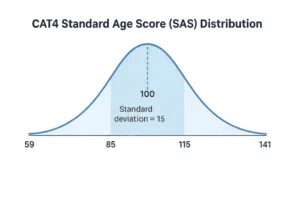
Range: 59 to 141
Average: 100
Standard deviation: 15
What it means: Shows how the student performed compared to other students of the same exact age (in years and months).
How to read it:
85–115 = average
Above 115 = above average
Below 85 = below average
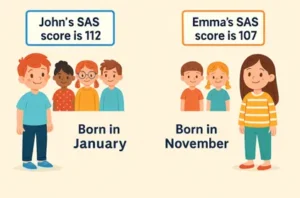
Example: Let’s say John and Emma study in the same class in Year 8. John’s SAS is 112, and he was born in January, while Emma’s SAS is 107, and she was born in November. They both have average SAS. But each of them is compared to the students who were born in his or her month:
If you want to read further information about the SAS, click here.
NPR (National Percentile Rank)
Range: 1 to 99
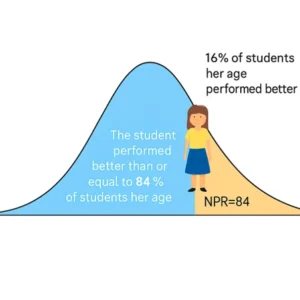
What it means: Shows the percentage of students your child or student performed equal to or better than, within the same age group.
Also referred to as “CAT4 percentiles.”
How to read it:
50 = average
75 = better than or equal to 75% of students
25 = better than or equal to 25% of students
Example: An NPR of 84 means your child or student performed better than or equal to 84% of students their age. It also means that 16% of students their age performed better. A student with an NPR of 84 is on the 84th percentile.
Stanine (Standard Nine)
Range: 1 to 9
What it means: Groups students into 9 broad performance bands based on their SAS scores.
How to read it:
1–3: Below average
4–6: Average
7–9: Above average
Why it’s useful: Stanines give a quick snapshot of performance. They help teachers and schools make decisions about support, enrichment, or placement — without focusing too much on small score differences.
Here is a real-world example:
Let’s say a student scores:
Stanine 8 in Spatial Ability → This student is excellent at visualizing shapes and space.
Stanine 4 in Verbal Reasoning → This student is average when it comes to understanding and working with the relationships between words.
If you want to read further information about Stanines, click here.
Group Rank (GR)
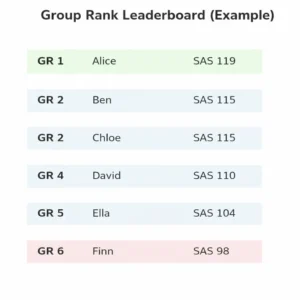
Group Rank (GR) shows the student’s position within the specific group of students who took the CAT4 at the same time (e.g., their class or year group). It is based on the students’ mean SAS scores, listed from highest to lowest — so GR 1 means the top score in the group, and larger numbers represent lower positions.
Unlike SAS, NPR, and Stanines, which compare the child to a national sample of same-age students, GR only compares them to the classmates who sat the test together.
If 20 students take the test, GR will range from 1 to 20.
If two students tie, they share the same rank, and the next number is skipped (e.g., 1, 2, 2, 4 …).
GR helps show where a child sits within their class group, but SAS and Stanines are more meaningful for understanding ability compared to national benchmarks.
In Detail - What Is the SAS Score?
The Standard Age Score (SAS) is the most important part of the student’s CAT4 results. It shows how your child or student performed compared to other students of the same exact age, measured in years and months. The SAS uses a national scale where the average score is 100, and the standard deviation is 15— meaning scores between 85 and 115 are considered average. The range of SAS scores is between 59 and 141:
Importantly, each child’s SAS is calculated by comparing them only to other students born in the same month. For example, a student born in January who scored 112 is being compared only to other January-born students, not to someone born in November. So if another student born in November scores 107, these two scores aren’t meant to be compared directly — each reflects performance relative to their age group:
SAS scores are given separately for each of the four CAT4 batteries:
Verbal Reasoning
Non-Verbal Reasoning
Quantitative Reasoning
Spatial Ability
This means parents and teachers can see how a student is doing in each specific area. These four scores are also averaged to produce a single overall mean SAS, giving a balanced view of your child or student’s general reasoning ability.
SAS scores are standardised using a nationally representative sample of UK students. Schools outside the UK use the same method. This means that even if you live in South Korea or the Emirates for example, your child/student’s SAS score reflects his or her performance compared to UK students.
In Detail - What are Stanines?
Stanine stands for Standard Nine — a simple way to group students into nine broad performance bands based on their Standard Age Scores (SAS). While the SAS is a precise number (like 103 or 118), stanines group these scores into categories so that they’re easier to interpret at a glance.
Stanine Scale and What It Means
Stanine
Interpretation
1–3
Below average
4–6
Average
7–9
Above average
Each stanine covers a range of SAS scores, and they follow a normal distribution — meaning most students fall in the middle stanines (especially 4, 5, and 6), and fewer students are found at the extremes (1-3 or 7-9).
Why Use Stanines?
Quick overview: Instead of analyzing multiple SAS scores across different batteries, a stanine instantly tells you if a student is performing below, at, or above the expected level for their age.
Less focus on tiny differences: SAS scores of 102 and 105 may feel different, but both might fall into stanine 5 — helping educators and parents focus on broader patterns rather than on small gaps.
Useful for schools: Stanines help schools make decisions about placement, support, enrichment, or monitoring progress over time.
How Are Stanines Calculated?
Stanines are calculated after the SAS score is determined. Based on how far that score is from the average (100), the student is placed into one of the 9 stanines. Here’s a general idea of how SAS scores map to stanines:
Stanine
Approximate SAS Range
9
126 and above
8
119–125
7
112–118
6
105–111
5
98–104
4
91–97
3
84–90
2
77–83
1
76 and below
Note: Exact cutoffs can vary slightly based on the test version and norm group.
CAT4 Scores Gifted and Talented
Many parents ask whether CAT4 determines giftedness. And the simple answer is no. The CAT4 wasn’t created to be a gifted test. However, the CAT4 is often used as a helpful screening tool for gifted and talented programs, and schools rely on it to help identify students with high reasoning potential.
Being gifted refers to advanced ability—no single test defines it.
Eligibility depends on the school or program’s criteria, which may include CAT4, grades, teacher recommendations, portfolios, etc. A child may be gifted but not meet a specific program’s requirements, or vice versa.
In other words, CAT4 does not determine giftedness, but helps determine eligibility for education services related to giftedness.
So how do schools use CAT4 to choose students for gifted programs?
Every school makes its own rules. Some may use a CAT4 score of 130 or above (SAS) as a signal of advanced ability; others will look at percentiles or stanines. There’s no universal threshold—what matters depends on the school or program.
Real examples of CAT4 use in schools
Here are three real-world examples of schools/programs using CAT4 as part of gifted identification:
Town Close School (UK) Their Gifted & Talented policy considers students with a CAT4 score of 130 or above in one or more areas as potential candidates, along with teacher assessments.
St Andrew’s Cathedral School (Sydney, Australia) They adopted CAT4 to spot gifted learners and guide support. While they don’t give a fixed score cutoff, they use the detailed CAT4 profile along with other data (like internal test scores) to decide eligibility.
Minarah College (Sydney, Australia) They apply CAT4 across all grades to reveal hidden abilities and support selection for accelerated programs, using the cognitive profile as part of their process.
Key tips for parents
Understand that CAT4 is not a designated “gifted test,” but it is widely used to screen for potential.
Program rules vary—ask your school:
Which CAT4 score do they count (overall vs. strongest battery)?
What cutoff do they use (e.g., SAS ≥ 130, top stanine)?
What other evidence supports eligibility (grades, teacher input, test scores)?
The most important step: talk directly with the school or program to understand their process.
How to Improve CAT4 Scores?
There is no magic, but here are a few steps that can definitely help the student improve his or her CAT4 scores:
Focus on strengths and weaknesses
CAT4 has four batteries: verbal, non-verbal, quantitative, and spatial.
Children are usually stronger in some and weaker in others — focus practice on the weaker areas.
Ways to improve skills in each area
Verbal: read widely, expand vocabulary, use word-learning apps.
Spatial/Non-verbal: try puzzles, pattern games, tangrams, or building activities (such as lego).
Quantitative: practice number puzzles, logical sequences, and mental math.
Get familiar with the test format and structure
Try CAT4 sample questions to understand how questions are structured. Here are relevant CAT4 sample pages:
When practicing, always read the solutions carefully — they often teach useful strategies.
Consider structured preparation
Preparation courses or packs with full-length CAT4 simulations, quizzes, videos, and study guides, can give some children the extra confidence needed and build stronger test-taking skills.
Frequently Asked Questions
What is a good CAT4 score?
There’s no single “good” score on the CAT4 — and for good reason:
Yes, technically a Standard Age Score (SAS) above 115 is considered above average, and scores between 85–115 are average. But what counts as “good” really depends on why your child is taking the test.
If your child is applying to a school or program: Each school has its own admission criteria. For example, a score of 117 might be enough for one school, but not for another. That’s why it’s so important to speak directly with the school to understand what they’re looking for — some focus on overall SAS, others may look at specific areas like verbal or spatial reasoning.
If your child took the CAT4 as part of school monitoring: Then there’s no such thing as passing or failing. The CAT4 helps teachers understand how your child thinks and learns — so they can better support them. In this case, the purpose is guidance, not judgment.
One more thing to remember: While the CAT4 provides an overall SAS score, that average can sometimes hide important details. For example, a student might have a high overall SAS due to strong verbal reasoning — but struggle in spatial or quantitative reasoning. That’s why it’s so important to look at each battery separately — not just the average.
Bottom line: A “good” CAT4 score depends on the context. The most helpful thing you can do is understand your child’s profile across the four reasoning areas — and talk to the school if admissions are involved.
What CAT4 score is gifted?
There isn’t a single CAT4 score that officially means “gifted.” CAT4 was not designed as a gifted test, but many schools use it as a screening tool for gifted programs. Commonly, scores around SAS 130+ (top 2%) or Stanine 9 are considered strong indicators of gifted potential—but each school or program sets its own criteria. Always check with your child’s school.
What is the CAT4 maximum score?
There are three distinct scores on the CAT4, which are associated with one another: SAS, NPR, and Stanines. The highest SAS is 141 (but If you are taking CAT4 levels X or Y, the highest SAS is 131). The highest possible NPR is 99. The highest Stanine is 9.
How do I get my CAT4 results?
Your child’s CAT4 results are sent directly to the school. The school then provides these results to you, typically in a parent-friendly report that helps explain the scores. The way you get the results depends on whether your child took the test on a computer or with paper and pencil:
For digital tests, the results are often available to the school immediately after the test is completed. The school will then process these and share them with you.
For paper-based tests, the answer sheets are sent to the test provider (GL Assessment) for scoring. This process can take up to 15 working days, after which the results are sent back to the school for them to share with you.